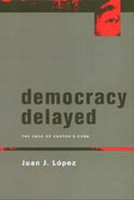
With the dissolution of the Soviet Union, foreign policy analysts and international relations scholars expected communist Cuba to undergo transitions to democracy and to markets as had the Eastern European nations of the former Soviet bloc. But more than a decade after the fall of the Berlin Wall, Castro remains in power, with no sign that the Cuban government or economy is moving toward liberalization. In Democracy Delayed, political scientist Juan López offers a searching and detailed analysis of the factors behind Cuba's failure to liberalize. López begins by comparing the political systems of three Eastern European states--the former German Democratic Republic, Czechoslovakia, and Romaniawith that of Cuba, in order to identify the differences that have allowed Castro to maintain his hold over the government and the economy. López also shows the various conditions promoting change, including the development of civil society groups in Cuba, and discusses why some U.S. policies help the possibility of democratization in Cuba while others hinder it. While the Catholic Church in Poland and the Protestant Church in East Germany fostered change, the Catholic Church in Cuba has not taken a defiant stance against authoritarianism but seems instead to be biding its time until Castro is out of the picture. In conclusion, López argues that a political transition in Cuba is possible even under the government of Fidel Castro. Some necessary conditions have been missing, but it is possible that U.S. policies could lay the groundwork for democratic charge.
With the dissolution of the Soviet Union, foreign policy analysts and international relations scholars expected communist Cuba to undergo transitions to democracy and to markets as had the Eastern European nations of the former Soviet bloc. But more than a decade after the fall of the Berlin Wall, Castro remains in power, with no sign that the Cuban government or economy is moving toward liberalization. In Democracy Delayed, political scientist Juan López offers a searching and detailed analysis of the factors behind Cuba's failure to liberalize. López begins by comparing the political systems of three Eastern European states--the former German Democratic Republic, Czechoslovakia, and Romaniawith that of Cuba, in order to identify the differences that have allowed Castro to maintain his hold over the government and the economy. López also shows the various conditions promoting change, including the development of civil society groups in Cuba, and discusses why some U.S. policies help the possibility of democratization in Cuba while others hinder it. While the Catholic Church in Poland and the Protestant Church in East Germany fostered change, the Catholic Church in Cuba has not taken a defiant stance against authoritarianism but seems instead to be biding its time until Castro is out of the picture. In conclusion, López argues that a political transition in Cuba is possible even under the government of Fidel Castro. Some necessary conditions have been missing, but it is possible that U.S. policies could lay the groundwork for democratic charge.
"Sometimes the best treasures in life arrive when least expect them"Ellie Walter has always done what was expected of her. Married to a man who is arrogant and extremely jealous, she is determined to...
When a local wildlife ranger goes missing in the rugged mountains south of Aspen, Colorado the local sheriff launches a massive manhunt. Buck Taylor volunteers to help in the search and what...
The Hello Delay asks what happens around the saying of a thing and the receiving. Inside and outside of our daily communications, there are events, there are silences, deja-vus, and intentions. These...
God, am I there yet?Have you ever been left perplexed by the difficult seasons in life and wondered where God was and why your breakthrough was taking so long? Delayed Takeoff takes a diagnostic...
Discover your next great read at BookLoop, Australiand online bookstore offering a vast selection of titles across various genres and interests. Whether you're curious about what's trending or searching for graphic novels that captivate, thrilling crime and mystery fiction, or exhilarating action and adventure stories, our curated collections have something for every reader. Delve into imaginative fantasy worlds or explore the realms of science fiction that challenge the boundaries of reality. Fans of contemporary narratives will find compelling stories in our contemporary fiction section. Embark on epic journeys with our fantasy and science fiction titles,
Shop Trending Books and New Releases
Explore our new releases for the most recent additions in romance books, fantasy books, graphic novels, crime and mystery books, science fiction books as well as biographies, cookbooks, self help books, tarot cards, fortunetelling and much more. With titles covering current trends, booktok and bookstagram recommendations, and emerging authors, BookLoop remains your go-to local australian bookstore for buying books online across all book genres.
Shop Best Books By Collection
Stay updated with the literary world by browsing our trending books, featuring the latest bestsellers and critically acclaimed works. Explore titles from popular brands like Minecraft, Pokemon, Star Wars, Bluey, Lonely Planet, ABIA award winners, Peppa Pig, and our specialised collection of ADHD books. At BookLoop, we are committed to providing a diverse and enriching reading experience for all.
Sign In
your cart
Your cart is empty
Menu
Search
PRE-SALES
If you have any questions before making a purchase chat with our online operators to get more information.